Health
State Health Dept Reassures Flint Park Parents
By Evelyn Ramirez
Advertisement · Why this ad?
Fatima holds a Bachelor's in Sociology and Communications from the University at Buffalo and has spent four years reporting on community issues for Rochester's grassroots publications. Her deep engagement with local neighborhoods informs her storytelling.
More from Fatima →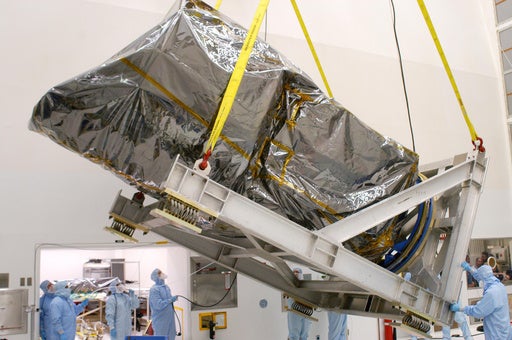
As the sun dipped below the horizon, casting a warm glow over Cape Canaveral, the team at NASA's Swift Observatory gathered for what felt like a bittersweet farewell. After 22 years of groundbreaking discoveries, the telescope, which has been a beacon of hope and knowledge in the realm of astrophysics, is on the verge of a fiery descent back to Earth. "It’s hard to say goodbye to something that has been such a part of our lives," reflected Dr. Brad Cenko, the mission’s chief scientist, as the team prepared for the inevitable.
The Swift Observatory, launched on November 20, 2004, has played a pivotal role in the study of gamma-ray bursts and supernovae, phenomena that illuminate the universe's most violent events. However, recent developments have revealed that the aging telescope is now barely clinging to its orbit. The U.S. Space Force has predicted that Swift will reenter Earth's atmosphere around Friday, marking the end of an era.
Despite a valiant rescue effort, which included attempts to stabilize the telescope's orbit, the mission ultimately fell short. As a result, the Swift Observatory is on a collision course with Earth, and while most of its 1.5-ton structure is expected to burn up upon reentry, some denser components, such as tungsten pieces and mirror parts, may survive the descent.
The impending demise of the Swift Observatory has resonated deeply within the scientific community and beyond. Local residents, many of whom have followed the telescope's journey, expressed a mix of sadness and gratitude. "It's like losing a family member. Swift has been a part of our lives for so long, contributing to our understanding of the universe," said Maria Rodriguez, a local science teacher who has used Swift's findings in her classroom.
Community members are gathering for a viewing event at the local planetarium, where they will commemorate Swift's contributions to science. “We want to celebrate what Swift has done for us, for the world,” said Dr. Cenko, who will also be attending the event. “It’s important to remember that this telescope has changed our understanding of the cosmos.”
Over its two decades in orbit, the Swift Observatory has made significant contributions to the field of astrophysics. It has detected over 1,000 gamma-ray bursts, providing invaluable data that has helped scientists piece together the life cycles of stars and the origins of the universe's most energetic phenomena. The telescope's ability to quickly locate and observe these bursts has made it an essential tool for researchers worldwide.
Dr. Cenko noted, “Swift has not only expanded our knowledge of the universe but has also inspired a new generation of scientists and astronomers. Its legacy will live on in the discoveries it has made and the lives it has touched.”
As the Swift Observatory prepares for its final descent, the implications for future research are significant. The data collected over its operational lifetime will continue to inform and inspire ongoing studies in astrophysics. Researchers are already analyzing the findings from Swift to explore new avenues of inquiry into cosmic phenomena.
“The end of Swift doesn’t mean the end of its impact,” said Dr. Cenko. “We have a wealth of data that will keep scientists busy for years to come. It’s a reminder of how important it is to invest in our understanding of the universe.”
Looking ahead, NASA is committed to continuing its exploration of the cosmos. The agency is actively developing new missions to study the universe, with plans for telescopes that will build upon the legacy of Swift. Projects like the James Webb Space Telescope are set to take center stage in the coming years, offering new insights into the mysteries of space.
As Swift makes its final journey, it serves as a poignant reminder of the importance of scientific exploration and the pursuit of knowledge. The community that rallied around this mission has gained not just data, but a deeper appreciation for the wonders of the universe.
In the days leading up to the telescope's reentry, local organizations are planning memorial events to honor Swift's contributions to science. The planetarium will host discussions, workshops, and viewings of the data collected by the telescope, ensuring that its legacy is preserved within the hearts and minds of future generations.
“We are excited to celebrate the life of Swift,” said Maria Rodriguez. “It’s a chance for us to come together as a community and reflect on what we’ve learned and what we can continue to learn from the universe.”
The Swift Observatory's impact extends beyond the scientific community; it has also played a crucial role in local education. Schools throughout the Rochester area have incorporated Swift's findings into their curricula, fostering a love for science among students. Local science fairs often feature projects inspired by the data collected by the telescope, encouraging students to explore astrophysics and related fields.
Many educators, like Rodriguez, have utilized the stories behind Swift's discoveries to engage students in complex scientific concepts. “When students hear about real missions and the discoveries that come from them, it makes science feel more accessible and exciting,” she said. “Swift has been a catalyst for curiosity.”
The team behind Swift has shared personal anecdotes about their experiences during the telescope's operational years. Dr. Cenko recalled the excitement of the first gamma-ray burst detected by Swift shortly after its launch. “We were all on pins and needles, waiting for the data to come in. When it did, it was like a light bulb went off. We knew we were onto something special,” he said.
Other team members have expressed their own sentiments of pride and nostalgia. “I remember the countless late nights spent analyzing data and discussing findings with my colleagues,” said Dr. Emily Chen, a project scientist. “Each discovery felt like a small piece of a much larger puzzle, and now that puzzle is coming to a close.”
The research conducted by the Swift Observatory has broader implications beyond the scientific community. Its findings have influenced fields such as cosmology, astrophysics, and even philosophy, as they challenge our understanding of existence and the universe. The data collected has led to discussions about the nature of reality, the origins of the universe, and humanity's place within it.
“Swift has opened doors to questions that we are just beginning to explore,” Dr. Cenko explained. “As we continue to analyze its data, we are uncovering mysteries that could reshape our understanding of the universe itself.”
As the Swift Observatory prepares for its final bow, the community of Rochester, NY, stands united in gratitude for the journey it has taken and the knowledge it has imparted. The stars may soon claim Swift, but its spirit will forever shine brightly in the hearts of those it has inspired.
By Evelyn Ramirez

By Frankie Thompson

By Marcus Lott

By James McCarthy